
Welcome to the Mathematical World!
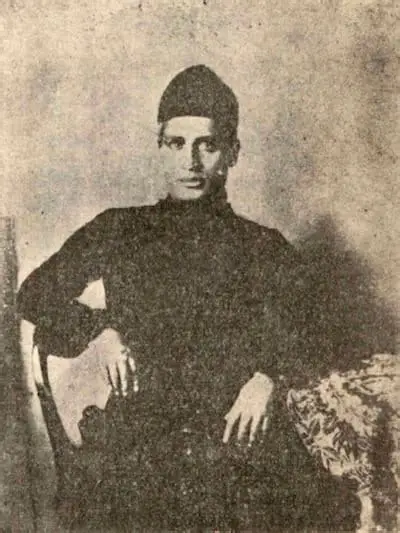
Radhanath Sikdar (1813–1870)
Mathematician and Geodetic Surveyor of Mount Everest
Radhanath Sikdar was an Indian mathematician and surveyor born in Jorasanko, Calcutta on 5 October 1813. He studied at Hindu College (now Presidency University), where his talent in mathematics was nurtured by John Tytler. Sikdar was also associated with the reformist “Young Bengal” circle around Henry Derozio.
Great Trigonometrical Survey (GTS)
In 1831, Sikdar joined the Great Trigonometrical Survey of India as a computer, working under Surveyor General George Everest and later Andrew Waugh. By 1851, he rose to Chief Computer, performing critical geodetic reductions and computations that formed the backbone of the Survey’s accuracy. Everest described him as “a hardy, energetic young man.”
Measuring the World’s Highest Peak
Using triangulation data from multiple stations, Sikdar concluded in 1852 that Peak XV was the tallest mountain on Earth. Andrew Waugh announced this in 1856, naming it Mount Everest after his predecessor. Sikdar’s computed height was approximately 29,000 ft; Waugh added 2 ft for official publication (29,002 ft). Modern measurements confirm his precision: 8,848 m (29,029 ft) in 1955 and 8,848.86 m (29,032 ft) in 2020.
Mathematical Contributions
Sikdar’s work involved meticulous geodetic computation: reducing angular observations, applying corrections for refraction, altitude, and curvature, and solving spherical-trigonometry triangles to convert sighted angles and baselines into peak heights. His expertise exemplifies the computational geometry and astronomy tradition of the GTS.
Other Scholarly and Civic Work
- Contributed technical chapters to the 1851 Survey Manual.
- Co-founded the Bengali monthly Māsik Patrikā in 1854 to promote women’s education.
- Protested injustice against survey workers (fined in 1843) demonstrating civic engagement.
- Retired in 1862 and taught mathematics at the General Assembly’s Institution (now Scottish Church College).
Legacy
Radhanath Sikdar exemplifies the Indian mathematical backbone of the Great Trigonometrical Survey. His precise spherical-trigonometry calculations, careful error corrections, and large-scale numerical computations were critical in establishing Mount Everest’s height. Without Sikdar’s expertise, the Survey’s discoveries and the famous “29,002 ft” figure would not have been possible. He remains celebrated as a pioneering mathematician and geodetic surveyor of India.

All rights reserved by the Mathematical Unity
Contact: +8801400044645
Email: mathematicalhorse1453@gmail.com
Our Discord Server: Mathematical Unity [Ulus Riyadiyat]